

Manufacturing Plant Roofing in Appleton, WI
Roofing for Paper Converting Plants and Mills Along the Fox River
Plant managers and facilities engineers running converting lines and process floors from Kaukauna to Neenah deal with a roof that most contractors have never actually worked over: one sitting on top of a building that generates its own steam, its own dust, and its own humidity load twenty-four hours a day. We build our roof assemblies and our fastening schedules around that reality, not around a generic warehouse spec.
Vapor Drive From Process Steam and What It Does to Insulation
A converting floor or a mill running paper machines pushes interior humidity well above what a standard office or warehouse assembly is designed for. That moisture wants to move toward the cold side of the roof deck in a Wisconsin winter, and if the vapor retarder is missing, poorly lapped, or punctured by an old mechanical penetration, it condenses inside the insulation. Wet polyiso loses R-value fast, and once a board is saturated it doesn't dry out on its own under a membrane. We check vapor retarder continuity on every re-roof over a wet process area before we spec anything above it.
On buildings where the interior humidity runs high year-round, we'll sometimes recommend a vented assembly or a secondary air barrier detail at the deck rather than relying on the membrane alone to manage moisture. It costs more up front. It also keeps a plant manager from finding soft insulation three winters later during a routine roof inspection.
Fastening Patterns and Wind Uplift Over Large, Unbroken Mill Roofs
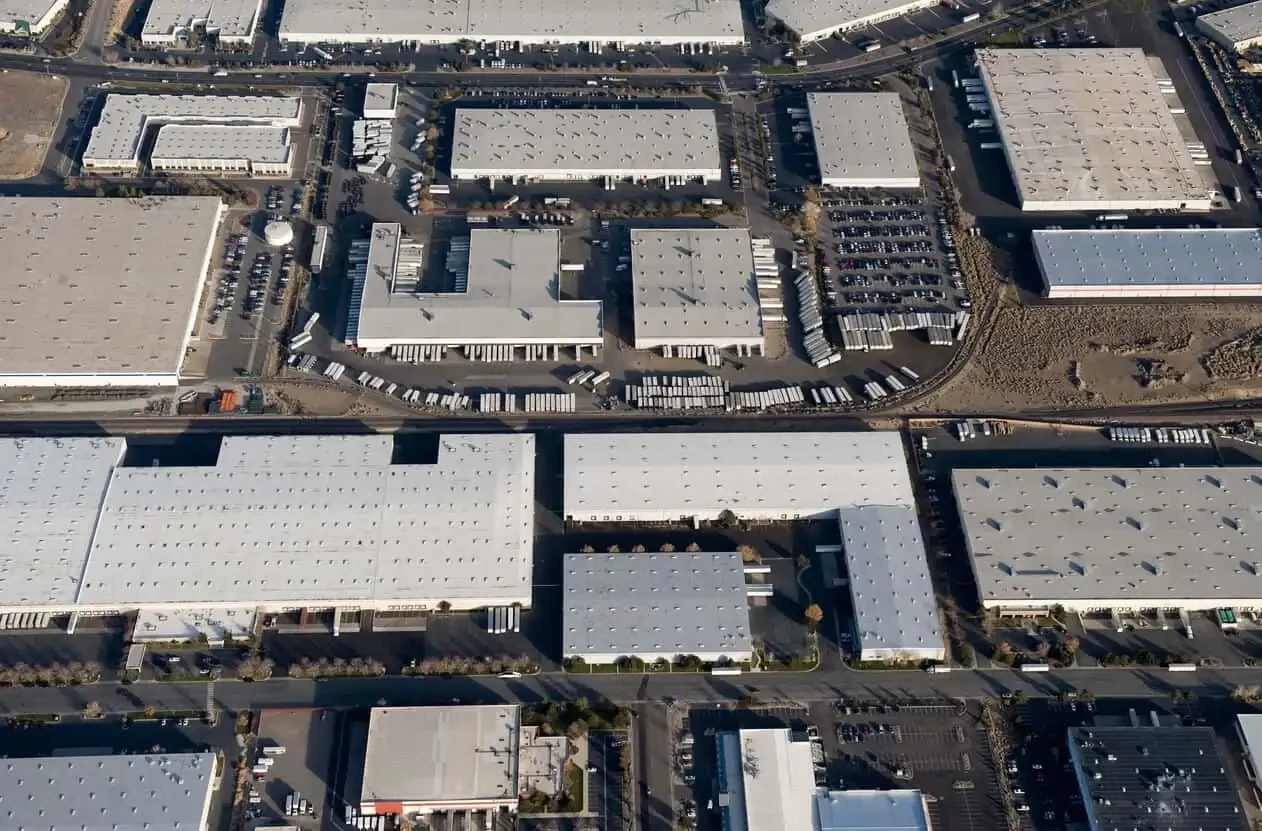
Converting plants and paper mills tend to have big, open roof fields with long runs between parapets and rooftop equipment. That geometry changes the wind uplift math. Corner and perimeter zones on a large low-slope roof carry a much higher uplift load than the field, and on a building with a long unbroken run, the field itself can act more like a perimeter condition once you factor in the building's height and exposure category. We calculate fastening density by zone rather than applying one pattern across the whole roof, and on buildings near open rail yards or river frontage where wind exposure is higher, we'll tighten the pattern further.
Mechanically attached single-ply is faster to install and easy to inspect, but a fully adhered system spreads uplift resistance more evenly and holds up better where dust builds around fastener plates. We size the system to the building's exposure, not to whichever install is quickest.
Dust, Lint, and Drainage on a Live Converting Floor
Paper dust and lint travel further than most facilities staff expect. It settles in roof drains, scuppers, and the intake screens on rooftop units, and it builds up in the low spots of a membrane where ponding already slows drainage. Clogged drains on a flat mill roof during a spring thaw are one of the more common calls we get from plant engineers who assumed the roof was fine because nothing was actively leaking. We clean and inspect drainage points as a standard part of our preventive maintenance visits on converting and mill buildings, not as an add-on.
Dust also affects how a membrane ages in traffic areas near mechanical equipment. A gray film of fines on TPO or PVC can mask early seam separation until it's a real leak. We keep traffic pads and walkway pattern down near equipment on active mill roofs specifically because that's where the dust load concentrates.
Membrane Chemistry Near Process Exhaust
Roofs near boiler stacks, dryer exhaust, or converting-process discharge see chemical exposure that a residential subdivision roof never encounters. PVC's plasticizer chemistry holds up better than standard TPO against oils, greases, and some solvent vapors, which is why we lean toward PVC membrane in discharge zones even when the rest of the roof runs TPO. EPDM handles UV and ozone well over the long field of a mill roof but is more sensitive to petroleum-based contamination directly under exhaust paths. Matching membrane chemistry to what's actually coming out of the stack matters more on a converting plant than on almost any other building type we work on.
Sequencing Roof Work Around a Line That Never Shuts Down
Most of our clients on this list can't give us a Monday-to-Friday, eight-to-five access window. Paper machines and converting lines run continuously except during scheduled shutdowns, and a roof crew working over an active process floor has to account for hot-work permits near exhaust stacks, staging that doesn't block rail spur or truck dock access, and fall protection plans that don't interfere with rooftop catwalks plant staff use daily. We plan phased work around a plant's actual production calendar rather than asking a client to shut a line down to fit our schedule.
When we're staging a full tear-off and replacement on a large mill roof, we break it into sections tied to the plant's own turnaround windows whenever the client's maintenance team can give us that calendar in advance. It's slower than a warehouse re-roof. It's also the only way to keep a converting operation running while the roof comes off in stages.
What We Look For on a Mill or Converting Plant Roof Walk
- Vapor retarder continuity at laps, penetrations, and curb transitions
- Insulation moisture content near stack penetrations and exhaust discharge points
- Drain and scupper condition where lint and dust accumulate fastest
- Fastener plate corrosion and backout in high-traffic maintenance paths
- Membrane condition directly downwind of boiler or dryer exhaust
- Coping and edge metal fatigue on long unbroken parapet runs
- Rooftop access points against current fall protection standards
Questions Fox Valley Plant Managers Ask Us
Can you work over a live production floor without shutting down our line?
Yes, and it's how most of our work in this sector actually happens. We section the work, schedule hot-work and fall protection plans around your operating hours, and coordinate staging with your dock and rail access so the roof crew isn't in the way of production traffic.
Our roof isn't leaking, so why did you flag wet insulation?
A membrane can stay watertight for years while the insulation underneath it is already saturated from interior vapor drive rather than a surface leak. We check this with moisture scans during inspections because it's a common failure mode on buildings with elevated process humidity, and it shows up as R-value loss and higher heating costs before it ever shows up as a drip.
Why would you spec PVC in one section and TPO everywhere else on the same roof?
Because the chemical exposure isn't uniform across a mill roof. Areas downwind of exhaust discharge or near process vents see contact with oils and solvents that PVC's chemistry resists better than standard TPO. Matching the membrane to the zone rather than using one product across the whole roof holds up longer in those specific spots.
How often should a converting plant get its roof drains checked?
More often than a typical warehouse. Paper dust and lint accumulate in drains and scuppers faster than debris does on most commercial roofs, and a clogged drain during a heavy rain or spring thaw can back up onto a low-slope field fast. We build drain and scupper checks into every maintenance visit on mill and converting properties rather than treating it as a seasonal task.
Do you handle roofs over both the mill and the attached office or warehouse space?
We do, and we treat them as different assemblies even when they're physically connected. The office and warehouse sections don't carry the same interior humidity or exhaust exposure as the process floor, so the vapor retarder detail, insulation package, and membrane chemistry can be simpler there even while the mill section next door needs the full treatment.